Automated sample stores are an essential infrastructure for modern life science laboratories. As sample volumes grow and laboratories scale automation, organizations increasingly rely on automated storage systems to improve sample integrity, accelerate retrieval, and reduce manual handling errors.
But automation alone does not create an intelligent laboratory.
Many labs discover that while automated stores solve critical physical storage challenges, they do not solve the broader operational problems surrounding sample visibility, workflow coordination, compliance, and data connectivity. Scientists may still struggle to locate the right samples, track sample movement across workflows, or connect storage activity with assay preparation, liquid handling, and downstream analysis.
Without integration into a broader sample management ecosystem, automated stores risk becoming isolated systems within an already fragmented laboratory environment.
Modern laboratories need more than automated storage. They need connected sample intelligence across the entire sample lifecycle.
The Limits of Standalone Lab Automated Stores
Automated stores deliver major operational benefits on their own. They help laboratories:
- Store and retrieve samples at high throughput with minimal human error
- Maintain sample integrity in secure, controlled environments
- Automatically track sample locations and barcode activity
- Optimize freezer capacity and storage utilization
- Reduce manual handling and scientist intervention
- Support unattended operation for improved productivity
However, automated stores typically focus on storage and retrieval functions. They are not designed to manage the full sample lifecycle or orchestrate complex laboratory workflows.
Questions quickly emerge:
- What happened to the sample before it entered storage?
- What happened after it left?
- Has the sample been diluted or depleted?
- Has it moved between workflows or facilities?
- Which assays used it?
- Is the chain of custody complete?
- Can scientists search for samples using scientific criteria rather than barcode IDs?
Answering these questions requires integration between automated storage systems and a modern sample management platform.
Why Sample Management Integration is Critical
A connected sample management system bridges the gap between physical sample storage and operational laboratory intelligence.
Rather than treating storage as an isolated process, integrated sample management connects automated stores with laboratory workflows, instruments, inventory systems, assay preparation, and automation platforms. This creates a unified operational environment where sample data remains traceable, searchable, and actionable throughout the entire lifecycle.
For laboratories scaling automation, this becomes increasingly important. As additional instruments, liquid handlers, scanners, and orchestration systems are introduced, disconnected workflows create operational bottlenecks that slow research and increase risk.
Integrated sample management systems solve this by centralizing sample visibility and workflow coordination across the lab.
Maintain Sample Integrity and Regulatory Compliance
Protecting sample integrity also means protecting data integrity.
In regulated environments, laboratories must maintain complete and accurate audit trails showing when data was created, modified, accessed, or deleted. Organizations must also demonstrate proper chain of custody, user authentication, controlled access, and secure record management.
The US Food and Drug Administration (FDA) continues to emphasize the importance of data integrity and traceability across laboratory operations. ¹
Disconnected spreadsheets and manual processes create significant risks in these environments. Manual updates increase the likelihood of errors, incomplete records, and inconsistent data handling. As laboratories expand automation infrastructure, maintaining compliance across siloed systems becomes increasingly difficult.
Modern sample management platforms help laboratories address these challenges by:
- Automatically logging sample actions and workflow events
- Maintaining complete audit trails across workflows
- Managing permissions and role-based access controls
- Supporting chain-of-custody tracking
- Reducing manual data entry and transcription errors
- Centralizing sample and workflow history
Platforms such as Mosaic by Cenevo are designed to support secure, traceable sample operations across complex laboratory environments while integrating directly with automation infrastructure and laboratory instruments.
Search and Retrieve Samples Faster
One of the biggest operational advantages of integrated sample management is the ability to search samples using meaningful scientific data rather than storage identifiers alone.
Scientists rarely think in barcode numbers. They search by concentration, compound type, assay history, storage conditions, plate information, or project context.
Integrated sample management systems connect automated storage databases with rich sample metadata, making it easier to identify and retrieve relevant materials quickly.
This becomes especially valuable in high-throughput laboratories managing millions of samples across multiple workflows and locations. Faster and more intuitive searching helps reduce delays, improve experiment planning, and eliminate unnecessary duplication of samples.
Modern platforms also provide visibility into the entire sample lifecycle, allowing laboratories to quickly identify expired materials, depleted samples, or assets requiring replenishment.
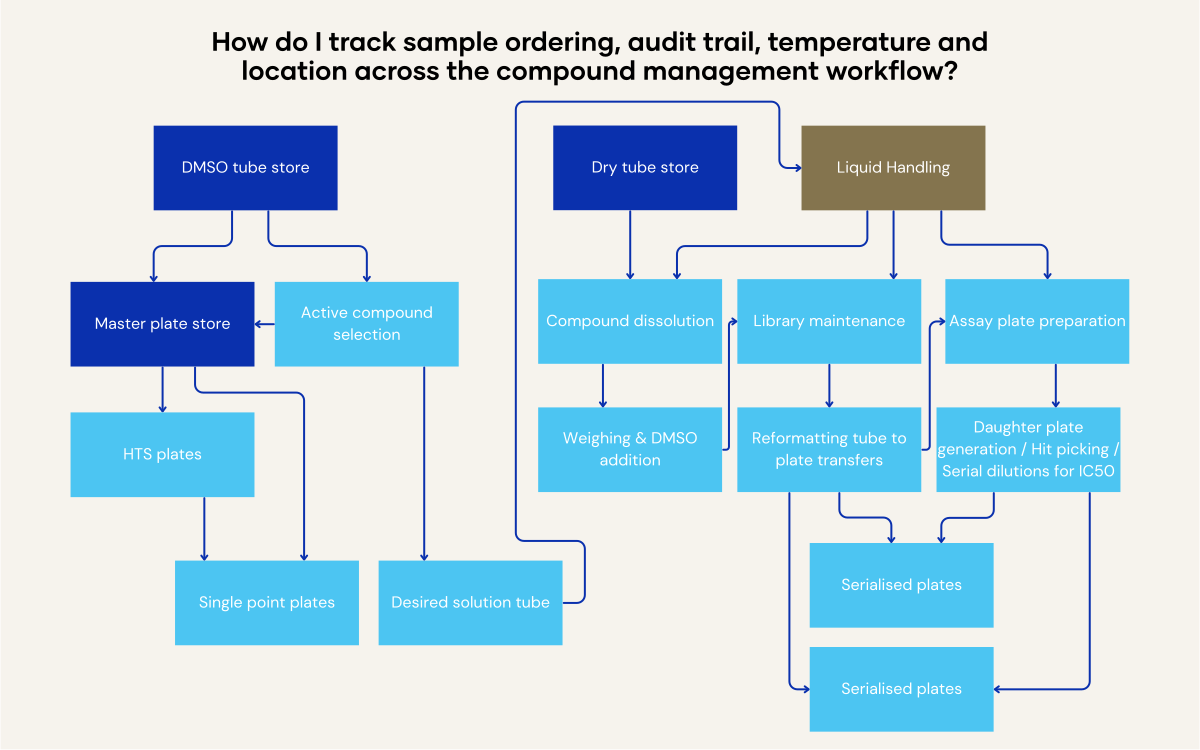
Track the Full Sample Lifecycle
Sample management does not stop at the automated store.
Once samples leave storage, they often move through highly complex workflows involving liquid handlers, assay preparation systems, laboratory instruments, transportation steps, and multiple user interactions.
Laboratories need complete visibility into what happens during every stage of that journey.
For example:
- Has the sample been diluted?
- Has the volume changed?
- Was the sample exposed to temperature variation?
- Was it transferred between sites?
- Which instruments processed it?
- Where is it now?
- Does it require replenishment or disposal?
Tracking these processes manually becomes increasingly difficult as automation expands.
Integrated sample management platforms connect these workflows into a single operational layer, automatically capturing sample movement, workflow events, and instrument activity across the laboratory ecosystem.
This creates a continuous, traceable record of the sample lifecycle while reducing the need for manual intervention and disconnected data transfers.
Connect Automation Across the Lab
Modern laboratories rarely operate a single automation system in isolation.
A typical environment may include:
- Automated sample stores
- Liquid handlers
- Barcode scanners
- Registration systems
- Analytical instruments
- Robotics platforms
- Inventory systems
- ELN and LIMS platforms
When these systems operate independently, laboratories often rely on manual file transfers, custom scripts, or disconnected workflows to move information between platforms.
This introduces operational inefficiencies, delays, and opportunities for error.
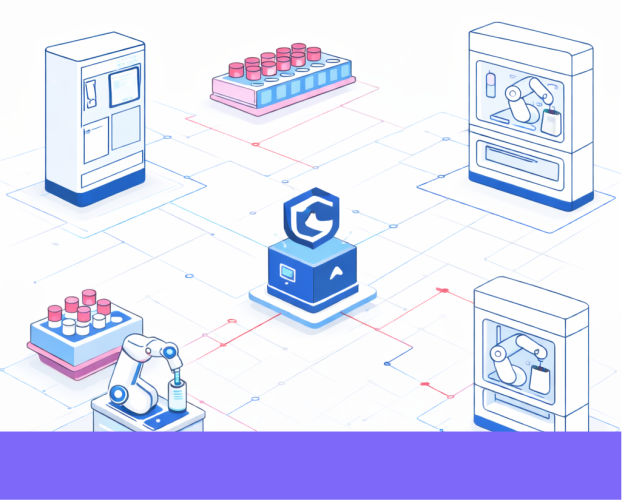
Integrated sample management platforms help laboratories orchestrate workflows across these systems from a centralized environment. Instead of manually coordinating individual steps, laboratories can automate and standardize processes across the entire workflow chain.
Mosaic by Cenevo enables laboratories to integrate automated stores and laboratory automation into unified workflows without relying on complex custom scripting or disconnected interfaces. Workflow changes, automation updates, and sample operations can all be managed from a single platform.
For fully interconnected and autonomous integrations where an automated store is coupled with liquid handling platforms, via a robot handoff, conveyor, or autonomous mobile robot (AMR), Mosaic can fully manage store picks and liquid handling work in an unattended and robust manner.
This simplifies automation management while improving scalability, traceability, and operational consistency.
Build an AI-Ready Laboratory Foundation
As laboratories increasingly explore AI-driven operations, connected sample data becomes even more important.
Artificial intelligence depends on structured, high-quality and traceable data. Laboratories with fragmented systems and disconnected workflows often struggle to generate the consistent operational data required for advanced analytics or AI applications.
AI-integrated sample management systems help create the data foundation required for AI-enabled laboratories by connecting:
- Sample operations
- Storage activity
- Instrument workflows
- Assay preparation
- Inventory movement
- Automation events
- User actions
When this data exists within a unified operational framework, laboratories can begin applying analytics and AI to identify bottlenecks, optimize workflows, improve utilization, and support faster scientific decision-making.
Connected sample management is becoming a foundational component of intelligent, data-centric laboratory operations.
The Operational Benefits of Integrated Sample Management
Integrating lab automated stores with a modern sample management platform delivers measurable operational and scientific benefits, including:
- Faster sample ordering and retrieval
- Reduced assay turnaround times
- Improved equipment utilization
- Lower risk of sample duplication
- Stronger compliance and audit readiness
- Reduced manual data handling
- Better scientist productivity
- Improved workflow scalability
- More efficient automation orchestration
- Higher data quality and traceability
Integrated workflows also reduce the errors and delays associated with manually transferring data between disconnected systems, helping laboratories operate faster and more efficiently without increasing operational complexity.
From Automated Storage to Connected Laboratory Operations
Automated sample stores solve critical physical storage challenges. But the real operational value emerges when those systems become part of a connected laboratory ecosystem.
By integrating automated stores with modern sample management platforms, laboratories gain visibility across the full sample lifecycle, improve workflow coordination, strengthen compliance, and create a scalable foundation for automation and AI-driven operations.
As laboratories continue evolving toward connected, intelligent research environments, integrated sample management is no longer simply operational infrastructure. It is a strategic foundation for modern scientific discovery.
To learn more about integrating automated stores with Mosaic – Book a consultation session with our integration experts

Reference
- US Food and Drug Administration (FDA). Data Integrity and Compliance With Drug CGMP Questions and Answers: Guidance for Industry. Silver Spring, MD; 2018.
* This blog was originally published on https://www.titian.co.uk/
%20(4).png)