Common Challenges Include:

Disconnected Systems & Manual Handoffs
Many labs rely on manual handoffs between systems, requiring operators to move data or files between platforms. This introduces delays, increases the risk of human error, and creates friction in otherwise automated workflows.

Limited Workflow Visibility
Without a unified view of workflow execution, it becomes difficult to track progress, identify bottlenecks, or troubleshoot issues. Teams often lack real-time insight into what is happening across instruments and processes.

No Built-In Recovery Mechanisms
When a run fails, many systems offer little support for recovery. This can result in repeated work, lost time, and uncertainty around data integrity, especially in high-throughput environments.
.svg)
Complexity Across Multi-Step Workflows
Coordinating workflows that span multiple instruments and systems can be challenging. As processes become more complex, managing dependencies, timing, and data flow becomes increasingly difficult.

Inventory Inconsistencies
Delayed or manual inventory updates often lead to discrepancies between expected and actual sample states. This impacts data reliability and can compromise downstream processes and results.

Limited Scalability Beyond POC
Solutions that perform well in controlled environments or early-stage setups often struggle to scale. As throughput increases, limitations in automation, integration, and system coordination become more apparent.
Workflow Orchestration
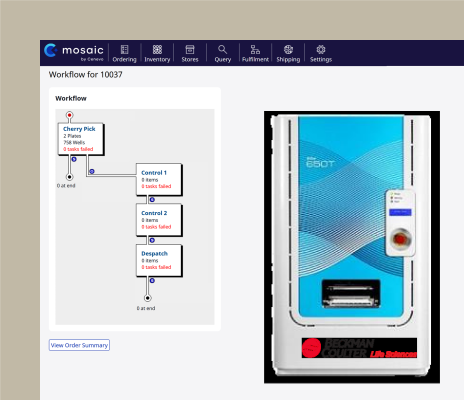
From Request to Execution - Fully Orchestrated
-
Worklists are generated automatically based on experimental requirements
-
Instructions are sent directly to the Echo liquid handler
-
Operators complete only a handful of guided steps on the instrument
The result is a fully connected workflow with no manual file handling and no disconnected systems.
Execution & Inventory Sync
Inventory That Updates Itself
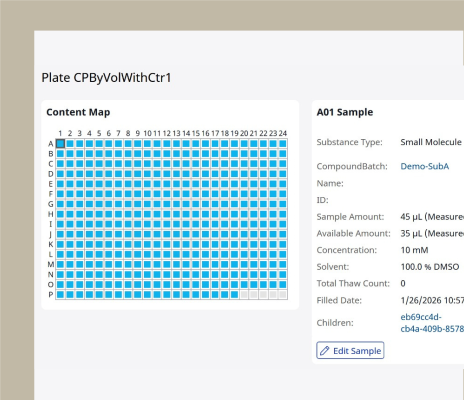
As Echo executes liquid handling steps, Mosaic continuously tracks and updates inventory in real time.
-
Sample volumes are adjusted automatically
-
Plate and well-level data stay synchronized
-
No need for manual reconciliation
This ensures accurate, synchronized inventory with no discrepancies and full confidence in every experiment.
Traceability & Compliance
Complete Traceability- Built In
Designed to support regulatory requirements, data integrity standards, and reproducible science in high-throughput environments.
-
Comprehensive audit trail capturing every action, timestamp, and user interaction across systems
-
Sample- and plate-level traceability, maintaining full lineage from source material through every transfer and transformation
-
End-to-end workflow history, preserving the full context of how and why each step was executed
- Integrated data visibility, eliminating gaps between systems and ensuring consistency across records
By preserving complete data continuity, you can eliminate gaps and ensure no context is lost throughout the workflow.

.svg)
Operator Experience
Simple for Operators. Powerful Behind the Scenes.
Designed to support regulatory requirements, data integrity standards, and reproducible science in high-throughput environments.
-
Guided execution steps, ensuring operators follow the correct process without needing to interpret complex protocols
-
Minimal training required, enabling teams to get up and running quickly across workflows and instruments
-
Reduced risk of human error, with system-driven instructions and automated data handling
- Complex automation managed in the background, including workflow logic, integration
This ensures consistency across operators, shifts, and sites, even in complex, high-throughput environments.
Ease of use matters. But in complex laboratory environments, simplicity without depth creates limitations.
Mosaic sample management combines intuitive interfaces with powerful configuration, helping labs automate complex workflows, integrate instruments seamlessly and scale operations without compromise.
.svg)