At a Contract Research Organization (CRO), sample management is not an isolated operational function: it sits at the center of delivery, client trust, and scientific execution.
Unlike internal pharmaceutical labs, CROs operate in multi-tenant environments. They handle samples originating from different sponsors, across multiple projects, timelines, and workflows, while maintaining strict separation, traceability, and compliance. At the same time, they are expected to deliver results quickly, transparently, and at scale.
This creates a unique operational tension: CROs must combine the rigor and reliability of large pharma compound management operations with the flexibility and responsiveness of a service organization.
In practice, this means that sample management is no longer just about inventory. It becomes a coordinated system of workflows, data, automation, and communication.
Why Traditional Approaches Fall Short
Historically, many CROs have relied on a combination of disconnected systems: spreadsheets, standalone LIMS, instrument software, and manual coordination between teams. While these approaches may function in limited scenarios, they break down as complexity increases. As the number of samples, workflows, and stakeholders grows, CROs begin to experience:
- Fragmented data across systems
- Delays caused by manual handoffs
- Increased risk of human error
- Limited visibility for clients
- Difficulty scaling operations without adding overhead
These are not just operational inefficiencies; they directly impact turnaround time, data confidence, and ultimately, competitiveness.
What CROs Actually Need from Sample Management
To operate effectively in today’s environment, CROs require more than a tracking system. They need an integrated capability that connects the full lifecycle of a sample - from intake to analysis to reporting.
This includes the ability to securely manage samples across multiple clients while maintaining strict data separation and access control. It requires real-time visibility into workflows, not only for internal teams but also for external stakeholders who increasingly expect transparency as part of the service.
Equally important is the ability to execute workflows consistently. This means reducing variability through automation, guiding users through predefined processes, and ensuring that every step is captured within a compliant audit trail.
At the same time, CROs must remain flexible. They need to support different sample types, adapt to changing protocols, and onboard new projects quickly, without relying on heavy IT involvement or custom development.
Taken together, these requirements point toward a clear conclusion: sample management must be part of a connected, integrated system, not a standalone tool.
The Role of Integration in Modern CRO Operations
This is where platforms like Cenevo’s Mosaic sample management solution become critical.
Rather than acting as a passive database, Mosaic functions as an orchestration layer across the lab. It connects instruments, automation platforms, data systems, and workflows into a unified environment.
In practice, this means that liquid handlers, automated stores, scanners, and analysis tools are no longer operating independently. Instead, they are coordinated through a central system that ensures data flows seamlessly between them.
👉 Learn more about lab system connectivity
The impact of this shift is significant.
When systems are connected, data no longer needs to be manually transferred. Workflows can be scheduled and executed more efficiently. Errors introduced by manual handling are reduced, and processes become both faster and more reliable.
From Fragmented Processes to End-to-End Lifecycle Management
One of the most important outcomes of integration is the ability to manage the entire sample lifecycle as a continuous process.
In a connected environment, a sample is no longer just “stored” or “processed” in isolation. Instead, it moves through a defined, traceable lifecycle:
-
It is registered and validated at intake
-
Stored in automated or manual inventory systems
-
Retrieved and processed through integrated workflows
-
Analyzed using connected instruments and software
-
Reported back to stakeholders with full traceability
Every step is recorded automatically. Every data point is linked. Every action is auditable.
This level of continuity enables CROs to deliver both speed and confidence at scale.
Data Integrity and Operational Efficiency
For CROs, data integrity is not just a regulatory requirement; it is foundational to client trust.
Disconnected systems introduce risk. Manual processes introduce variability. Together, they create gaps in traceability and increase the likelihood of errors.
By contrast, integrated systems eliminate many of these risks.
These benefits are not theoretical; they are already being realized in production environments:
David Cronk, Director of HTS Sciences at Charles River, explains:
“We have multiple data management systems across the organization, including chemical registration and screening platforms like ActivityBase and Genedata Screener, all interfaced with Mosaic. These connections allow us to track samples seamlessly across systems and maintain continuity throughout the workflow.”
As Denise Swift, Senior Scientist at Sygnature Discovery, said:
“The important thing about Mosaic for us is that it allows us to maintain data integrity. It bypasses the need for human intervention, so there should be no errors.”
This is a critical point. The value of integration is not only efficiency; it is consistency, reliability, and auditability.
👉 Learn more about LIMS and data management
Client Connectivity: From Visibility to System-to-System Collaboration
For CROs, client communication is no longer a reporting layer—it is part of the operational workflow itself.
Sponsors increasingly expect to interact with CROs in real time. They want to submit requests, track progress, and access results without relying on manual updates or fragmented communication channels. This shift is not just about convenience; it directly impacts decision-making speed and overall program timelines.
To support this, modern CROs need to move beyond static portals or email-based coordination toward structured, system-driven collaboration.
This is where two capabilities become critical: the Customer Portal and the Connector.
Customer Portal: Structured, Secure Client Access
The Mosaic Partner Portal provides a controlled interface for external stakeholders to interact with CRO operations. Rather than relying on spreadsheets, emails, or ad hoc reporting, clients can:
-
Submit sample requests directly
-
View inventory and availability in real time
-
Track workflow progress
-
Access results and reports
-
All interactions are governed by strict permission models, ensuring that each client only sees their own data.
More importantly, the portal is not a passive dashboard; it is connected to the underlying workflow engine. This means that every request, update, and result is part of the same traceable system used internally by the CRO.
Connector: True System-to-System Integration
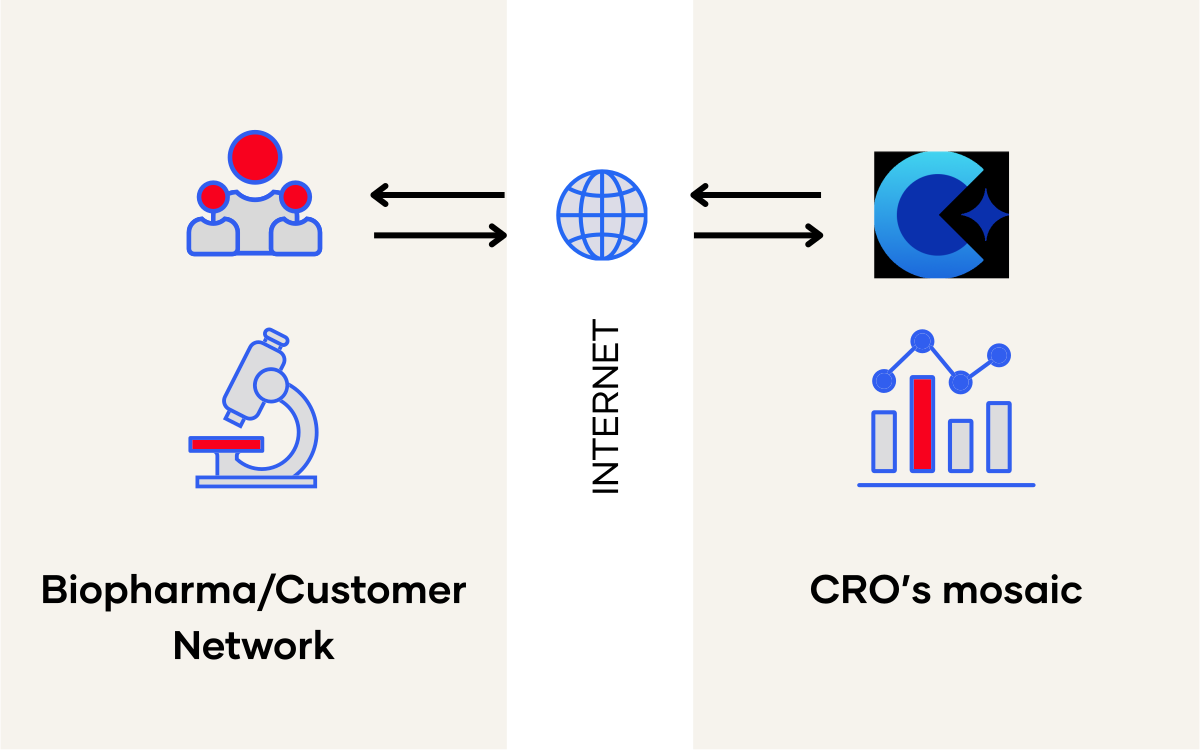
While portals improve visibility, many large sponsors require a deeper level of integration. They do not want to log into another system. They want CRO services to integrate directly into their own digital infrastructure.
The Mosaic Connector enables exactly this.
It allows sponsors using Mosaic (or compatible systems) to:
-
Create and submit requests directly from their own environment
-
Trigger workflows within the CRO without manual intervention
-
Receive updates and results back into their own systems
This creates a bidirectional, system-to-system connection between the sponsor and the CRO.
In practice, this eliminates duplicate data entry, reduces delays, and ensures full continuity between organizations.
Automation as a Foundation for Scale
Automation plays a central role in enabling CROs to scale operations without increasing complexity.
However, automation alone is not sufficient. The real value comes when automated systems are connected and orchestrated as part of a larger workflow.
When automation is integrated with sample management:
-
Processes become repeatable and standardized
-
Throughput increases without sacrificing quality
-
Errors are reduced at the source
-
Data is captured automatically at every step
👉 Explore how AI and automation are shaping modern labs
This creates an environment where CROs can deliver faster results while maintaining full control and traceability.
Toward the Connected and Agentic Lab
The evolution of sample management reflects a broader transformation in laboratory operations. CROs are moving away from fragmented systems toward connected, intelligent environments where workflows, data, and automation are fully integrated. This shift is also what enables the next layer of capability: AI.
When data is structured, connected, and accessible, it can be used not only for tracking and reporting, but also for optimization, prediction, and decision support.
This is the foundation of the agentic lab - where systems do not just store information but actively help drive outcomes.
Conclusion
Sample management in CROs is fundamentally different from traditional lab environments.
It requires balancing complexity with speed, flexibility with control, and transparency with security.
To meet these demands, CROs need systems that go beyond tracking and storage. They need platforms that integrate workflows, connect systems, and enable real-time collaboration.
This is why many CROs adopt Mosaic as it provides:
In an environment where operational excellence is a competitive differentiator, sample management becomes a strategic capability rather than just an operational one.
To learn more about how Cenevo can help with your needs

*Previously published on https://www.titian.co.uk/