.png?width=44&height=44&name=Keith%20(1).png)
For more than 30 years I’ve worked as a technologist across multiple industries, and over the last 15 my teams and I have run annual surveys to better understand market dynamics and the forces shaping each sector including the last two as CEO of Cenevo. The results from this year’s survey for the life sciences and lab operations markets have been more revealing than I’ve ever seen before. The life sciences industry has made extraordinary advances over the last two decades and has a massive opportunity ahead, particularly with AI amplifying and accelerating scientific discovery. However critical industry challenges persist, particularly funding pressures in biotechs, leaving many labs reliant on legacy applications and disconnected instruments, causing a proliferation of fragmented data. The result is that scientific discovery and the development of new drugs, for example, remains slower, more manual and costly than it should be.
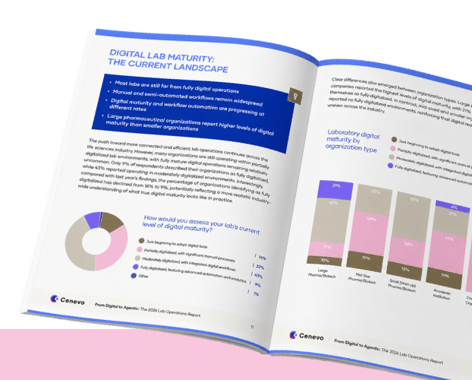
This year’s Lab Operations Report shows the data behind my perspective, and the findings are striking enough that I want to share not just the numbers, but what I think they mean for the future of the lab.
The Gap Between Intent and Execution of AI
The headline is clear: AI adoption in lab operations is no longer a question of when. It is already happening. 60% of labs are exploring or piloting generative AI. But only 5% are using agentic AI in full production.
That gap between intent and live application is the most striking outcome from the survey, which on reflection isn’t surprising given the pace of change of AI across industries. The results signal that the life sciences industry is at the beginning of a major shift in approach, but that the practical conditions for agentic adoption at scale are still being explored. Connected instruments and systems, secure, coherent and consistent data combined with strong governance and regulatory compliance are key concerns that take time to assess and address.
What Labs Look Like Today
What numerous clients tell me and what I’ve seen for myself is that many labs operate something like the diagram below. There are multiple human handoffs and manual checks between and within stages in the experimental process. PDFs, spreadsheets, paper records, bespoke databases, partially utilized Inventory, Registration, ELNs and LIMS applications, often unconnected or loosely integrated devices and instruments requiring human intervention to check and move data and processes from one step to the next. From thesis to experiment design, lab execution, data collection, analysis and results, there are numerous people bridging the gaps, rather than actually undertaking real scientific work.
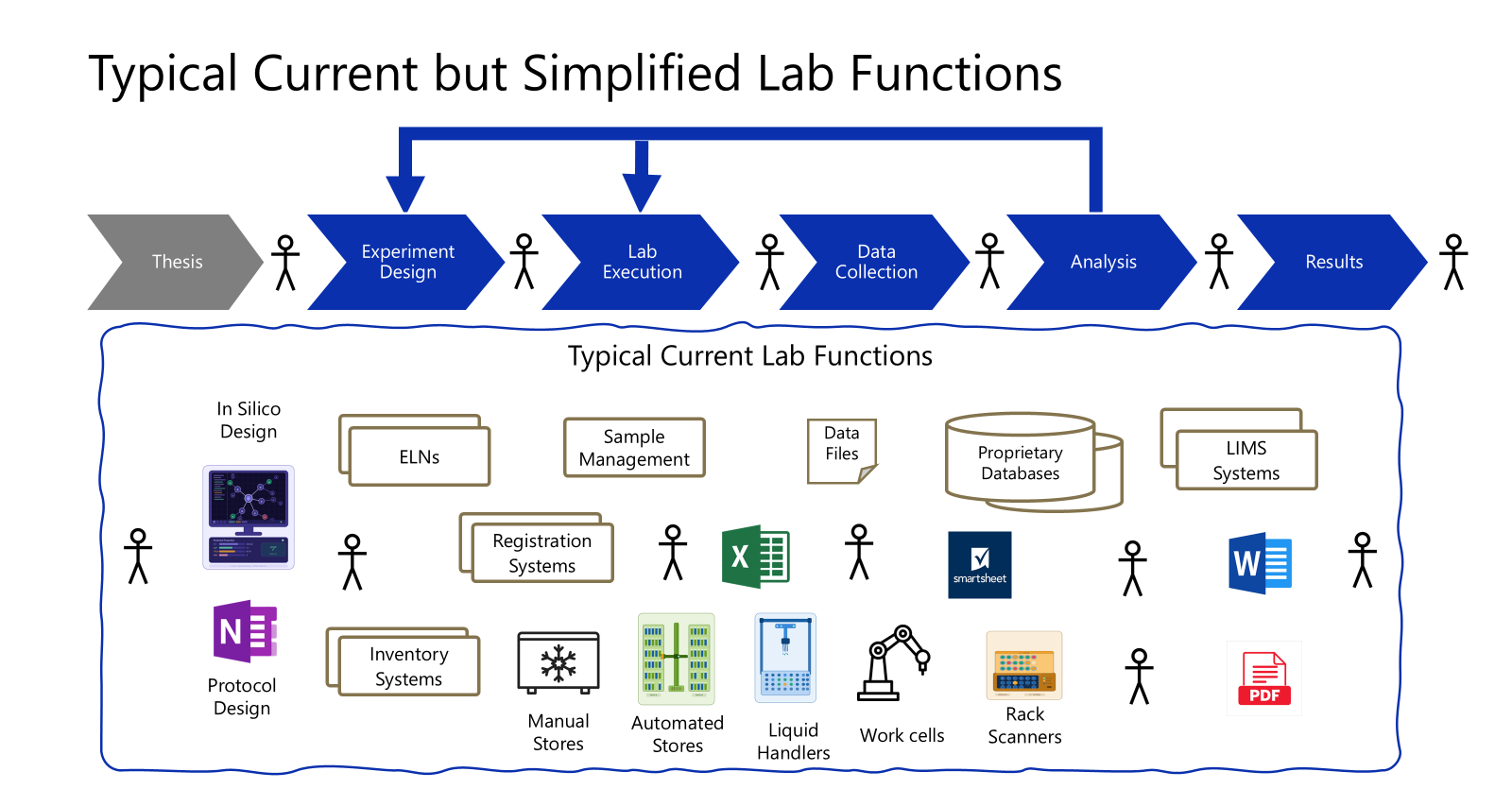
Bench scientists, sample management teams, lab technicians, technology and data specialists are often doing extraordinary work and being asked to do more and more but under constraints of available resources, tools, technology and indeed funding for change. This is an honest if simplified picture of where many labs are today, and it explains why 55% of our survey respondents cite lack of integration between systems as their biggest barrier to making effective use of lab data. The infrastructure simply was not built for the world we are moving into.
Is the Waymo Moment Coming to Labs?
Until fairly recently, fully automated driverless taxis felt like science fiction (remember Johnny Cab in the 1990 film Total Recall?) Today it is a reality in several US and Chinese cities and has even been tested in London. The ‘human in the loop’ is still behind the wheel in London, perhaps due to the complexity of the roads and driving culture in the UK. My experience from the rides I’ve taken with Waymo is good, though not yet quite as seamless as a human-driven car.
I also reflect on my experience in financial technology over the last 30 years and change there – when was the last time you wrote a cheque, received a share certificate, traded on open outcry exchanges, or waited several days for money to be transferred? Today we verify identities for AML purposes electronically, transfer cash in seconds, and trade online without a second thought, all driven by ‘straight-through-processing’, automation and digitalization in financial services. There may be a perceived increased risk, but the banking controls and financial regulations are used to mitigate those worries. Behind the user’s digital experience, there are still people, but they are reviewing and managing exceptions to workflow driven digital rules engines, rather than undertaking or checking each step. In 2010, I was told blockchain technology would remove the need for many parts of banking, since you would no longer need a reliable intermediate or clearing mechanisms. More than 15 years later banks continue to provide many of these services in a controlled and regulated manner, with human-in-the-loop (even though it wasn’t called that then), but in many orders of magnitude more efficient than they were in the 1980s and 1990s.
Automated taxis and the digitalization of financial services did not arrive all at once and are still being improved. It has been built incrementally, with safety systems layered on top of each other, human oversight maintained at every stage, and trust earned through demonstrated reliability before autonomy was extended further.
The Agentic Connected Lab
The agentic connected lab will follow a similar trajectory in my opinion. The future of a fully autonomous lab taking a thesis from experimental design, to execution, to data collection, to analysis (with iterations such as DMTA) to final results without any human intervention will be possible in future, but like the Waymo cabs or financial service technology, it will take time to be proven and rolled out across different types of labs, stages of scientific discovery, experiments and the various modalities in drug development for example.
In the interim, agents will inevitably handle the repetitive, structured, laborious work, such as reporting, assay plate ordering, data collection and cleansing, sample housekeeping and assay development, by creating workflows using natural language and prompts rather than complex coding or configuration of systems. This will free scientists to focus on the work that requires genuine scientific judgment. Not a lab without scientists, but a lab where scientists are doing genuinely scientific work, rather than manual, mundane and repetitive tasks.
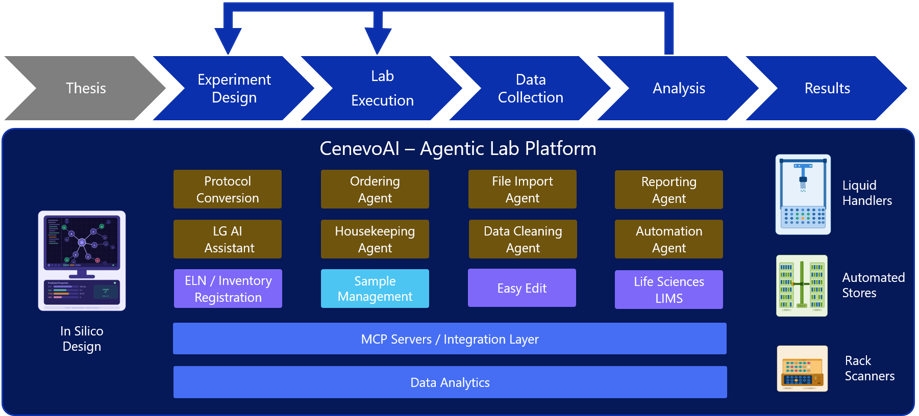
Our vision at Cenevo is agents operating across the full experimental workflow, from design through to results, with scientists-in-the-loop where it matters most. Not replacing scientific judgment but removing the work that consumes it.
Accelerating Adoption of AI
58% of respondents cite privacy and security concerns as their top barrier to AI adoption. 51% point to lack of skills and training. These are not objections to AI in principle. They are legitimate requirements to ensure that AI is trustworthy and safe in practice.
One finding did surprise me: when we asked respondents about the main barriers to AI adoption, regulation and validation came low down the list. Governance or regulatory constraints were cited by just 23% of respondents, well behind privacy concerns, skills gaps and data quality.
Yet in almost every conversation I have had with lab leaders and scientists over recent months, regulatory compliance is key. Validated systems, audit trails, GxP compliance, and ISO standards are not peripheral concerns for life science organizations. They are central to how labs operate, and they become significantly more complex as operations become more agentic and autonomous.
Regulatory compliance will likely become increasingly prominent as the industry moves from generative AI pilots toward production agentic deployments. The bar for trust, validation and governance will likely increase as AI takes on more autonomous decision-making in regulated environments.
The future winners in life science will be those that combine scientific expertise, proprietary biological and chemical data, strong wet-lab capability, regulatory compliance and computational infrastructure with scientists-in-the-loop in my opinion. Agentic AI can narrow search spaces, accelerate iteration cycles and automate the repetitive manual tasks giving scientists back the time to focus on hypothesis, insight and interpretation.
The agentic lab must be a trusted lab. In life science, that means validated systems, complete audit trails, and governance that meets GxP and ISO standards. Agility and flexibility matter, but not at the expense of the compliance frameworks that protect scientific integrity and patient safety. Organizations that treat compliance as a foundation, rather than a constraint, will be best placed to move fast without breaking trust.
The Road Ahead
The organizations that will benefit most from agentic AI in the lab are those investing now in the right foundations: connected data, integrated infrastructure, and governance built for autonomous systems. The technology is moving fast. The question is whether the organizational and regulatory conditions can keep pace.
The full Lab Operations Report provides a detailed, data-driven picture of where life science labs stand today on digital and agentic maturity based on your feedback. The agentic connected lab is not a distant aspiration, it is what we at Cenevo are and will continue to build in close collaboration with our customers.
%20(4).png)