The pressure to accelerate drug discovery has never been greater. Research organizations must increase throughput, improve data quality, and reduce manual processes, all while maintaining complete traceability across increasingly complex laboratory environments.
Achieving these goals requires more than automation alone. It requires connected workflows that bring together sample management, liquid handling, storage systems, and laboratory software into a unified operational framework.
Several technology providers, including Beckman Coulter Life Sciences (formerly Labcyte), Azenta (formerly Brooks), Tecan, and Titian Software (now part of Cenevo), worked together with a leading pharmaceutical company to develop an integrated acoustic workflow designed to improve efficiency, scalability, and data quality throughout the sample preparation process.
In addition to improving throughput and data quality, many organizations are adopting acoustic workflows to support miniaturization strategies. By transferring highly precise, ultra-low volumes, acoustic liquid handling can help reduce compound consumption, lower reagent costs, minimize disposable plastic usage, and generate more data from limited sample inventories. These benefits not only improve laboratory efficiency but also contribute to sustainability initiatives and reduce the overall cost of drug discovery.
Why Acoustic Workflows Matter
Acoustic liquid handling has transformed compound management and screening workflows by enabling highly precise, non-contact liquid transfer at extremely small volumes.
Organizations adopted acoustic technologies for several key reasons:
- Improved data quality and consistency
- Faster processing through highly automated workflows
- Reduced reagent consumption through miniaturization
- Lower s reagent and costs
- Reduced disposable plastic and consumable usage
- Greater sustainability and reduced laboratory waste
- More efficient use of valuable sample inventories
- Increased efficiency across screening operations
As compound libraries become increasingly valuable and sustainability initiatives gain importance across the life sciences industry, these benefits have become even more significant. By transferring highly precise volumes measured in nanoliters rather than microliters, acoustic workflows enable laboratories to run more assays from the same inventory while reducing reagent costs, minimizing plastic waste, and preserving precious samples for future research.
A Partnership Built Around Integration
Delivering a fully integrated acoustic workflow required close collaboration between multiple vendors, each contributing expertise in automation, sample storage, liquid handling, and software orchestration.
This approach remains highly relevant today. Modern laboratories rarely rely on a single platform or vendor. Instead, they depend on connected ecosystems of instruments, automation platforms, inventory systems, and software applications working together seamlessly.
Titian's philosophy was simple: scientists should be free to choose the technologies that best fit their needs while maintaining a consistent and reliable operational workflow.
Today, that same philosophy continues within Cenevo's approach to connected laboratory operations.
Mosaic as the Orchestration Layer
At the center of the workflow was the Mosaic sample management platform.
Mosaic served as the orchestration layer connecting scientists, automation systems, storage platforms, and liquid handling technologies through a unified workflow.
The platform delivered value in two critical areas:
Simplified Sample Ordering
Scientists could request compounds and samples through an intuitive interface without needing to understand the complexity of the underlying automation processes.
In many cases, ordering systems could interact directly with Mosaic through APIs, allowing organizations to support multiple request channels while maintaining a single source of operational control.
Automation and Workflow Coordination
Mosaic coordinated activities across storage systems, liquid handlers, and processing equipment to ensure work progressed efficiently from sample request through assay-ready plate generation.
This included:
- Managing large sample retrieval requests from automated stores
- Coordinating batch processing across multiple systems
- Supporting high-throughput screening workflows
- Guiding operators through standardized processes
- Maintaining complete traceability throughout execution
By orchestrating these activities centrally, Mosaic reduced manual intervention while improving reliability and scalability.
Simplifying Acoustic Liquid Handling
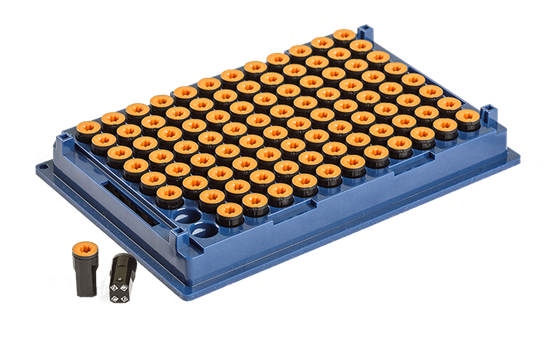
One of the most significant developments was the integration of Mosaic with Beckman Coulter's acoustic liquid-handling platform.
At the time, Mosaic's Tempo Fulfilment Module (TFM) simplified the setup and execution of acoustic workflows by automating tasks that traditionally required manual calculations, spreadsheet manipulation, and file transfers.
Operators could:
- Generate run configurations automatically
- Create dose-response curves without manual calculations
- Process acoustic tube and source plate orders
- Update inventory volumes and concentrations automatically
- Capture operational data throughout the workflow
As processes progressed, Mosaic collected data from liquid handlers, bulk fillers, and supporting systems while maintaining accurate inventory records and a complete audit trail.
This level of automation helped eliminate common sources of human error and reduced the operational burden on laboratory teams.
Real-Time Visibility and Traceability
One of the most valuable outcomes of integration was real-time visibility into sample inventory and workflow status.
Rather than waiting until the completion of a process, scientists could view updated inventory information as work progressed through the system.
Operational data collected during execution could also be used to identify issues such as evaporation, insufficient volumes, or sample quality concerns.
Because every action was recorded, laboratories gained the ability to trace problems back to their source, supporting both operational efficiency and data integrity.
This principle remains a core requirement for modern automated laboratories.
Driving Measurable Performance Improvements
The integrated workflow delivered significant benefits across sample management and screening operations:
- Faster turnaround times
- Higher throughput through parallel processing
- Reduced manual intervention
- Improved data quality
- Greater sample conservation
- Simplified workflow execution
- Complete auditability and traceability
Automated calculations and workflow optimization also helped reduce compound consumption, lower reagent costs, minimize laboratory waste, and decrease reliance on disposable consumables while ensuring consistent execution across large screening campaigns. By supporting miniaturized workflows, organizations can maximize the value of their sample collections, improve resource utilization, and accelerate research without increasing operational complexity.
The Foundation of Today's Connected Lab
Although this project was originally developed several years ago, many of the concepts remain central to laboratory modernization efforts today.
What was once described as integration is now often referred to as laboratory orchestration: coordinating instruments, automation platforms, inventory systems, and scientific data through a connected operational framework.
These principles continue to underpin Cenevo's Mosaic platform, helping life science organizations create laboratories that are automated, data-centric, and ready for AI-driven innovation.
As laboratories continue to scale automation and adopt advanced technologies, the ability to connect systems and orchestrate workflows remains one of the most important drivers of efficiency, reproducibility, and scientific success.
To learn more about Mosaic integration with acoustic liquid handlers

Originally published on www.titian.co.uk, updated for Cenevo.
%20(4).png)